Doglish
Introduction
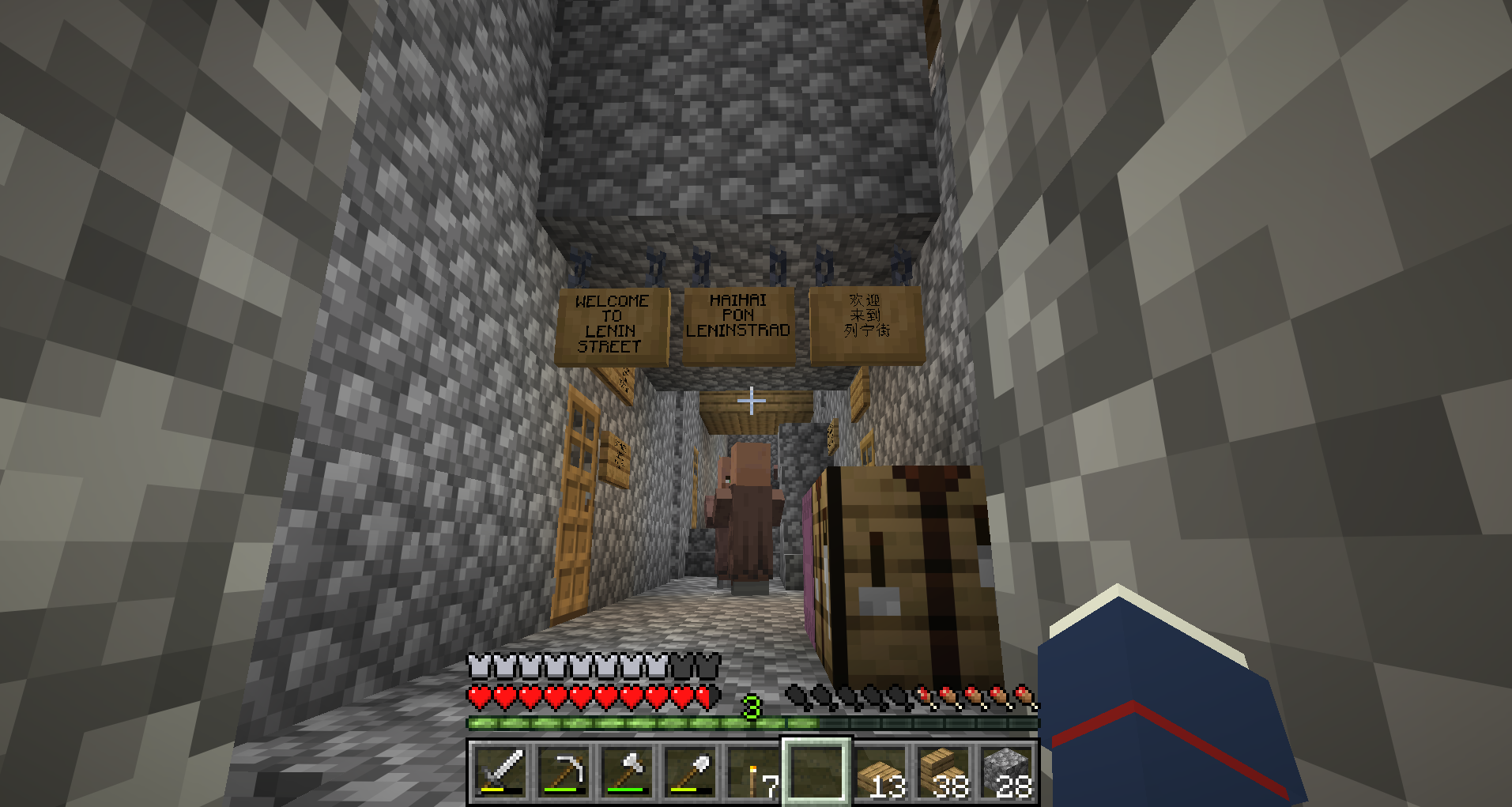
This is a basic guide to speaking Doglish, a dialect of English I created for my Minecraft slum Dogtown. It's meant to be analagous to Singapore's Singlish. In-lore Dogtown is very Russian and Chinese, and it takes a lot of influence from Russian especially.
Generally, although created for Dogtown, I plan to apply it to English in my other slums where applicable.
Contents:
- Spelling
- Basic Vocabulary
- Some Grammar
- Other Vocabulary/Slang
Spelling
Because this isn't a standardized dialect, Doglish can be spelled however you want. Below are a few norms, though.
- The dental fricative sound “th” is not present in Doglish. In common words, this is replaced by “d” which is reflected in spelling. In specific/uncommon words, it is replaced by an aspirated “t” most commonly, but a “d” sound will work too.
- In common words, the trailing “g” on words like “thing” are not pronounced, so “thing” translates to “din”.
- The English word “and” is spelled and pronounced in Doglish as “in”. The English word “in” is replaced by something else in Doglish, which I'll elaborate on in the next section, Basic Vocabulary.
Example
English: I think there's a new faith healer or something on Lenin Street.
Doglish: I think seta new faith healer or somedin pon Leninstrad.
Doglish pronunciation: I tink seta new fait healer or somedin pon Leninstrad.
Basic Vocabulary
Pon (from English “upon”) - upon, on, in, at
Example
Doglish: Dog it sleep pon me house.
English: A dog is sleeping in my house.
Pud (pronounced “pood”, from Latin “apud”) - by, near, among
Example
Doglish: Casino pud house Razumikhina it fuck me every time.
English: The casino by Razumikhin's house fucks me over every time.
Seta (from French “c'est un”) - there is, there are
Example
Doglish: Seta new cafe pon Leninstrad.
English: There's a new cafe on Lenin Street.
-n- (like French “-t-”) - Used to improve sentence flow.
Example
Doglish: Give'ya-n-it some food.
English: Give it some food.
Seb (from Russian “себя/sebya”) - Reflexive pronoun.
Example
He give me seb food. -> He gives me his (own) food.
He give me his food. -> He gives me his (as in another male's) food.
Done - Denotes past tense when used before a verb.
Example
Doglish: He done give me some food.
English: He gave me some food.
Jawi (from Chinese “將會/jiānghuì”) - Denotes future tense when used before a verb.
Example
Doglish: He jawi give me some food.
English: He is going to give me some food.
Dis (from English “this") - this, is. See the next section for more information.
Example
Doglish: Dog dis very smart.
English: The dog is very smart.
Ain (from English “ain't") - not, doesn't, isn't
Example
Doglish: Walk here pon night it ain allow.
English: Walking here at night isn't allowed.
Li (from Russian “ли/li”) - if. Used in the middle of sentences for yes or no questions.
Example
Doglish: She ain know li seb got class today.
English: She doesn't know if she has class today.
Zhe/zh (from Russian “же/zhe") — Adverb, accentuates the mood of the speaker. Zh and zhe are interchangeable.
Example
Doglish: Stop'ya-n-yap, I zh concentrate!
English: Shut up, I'm concentrating!
La (from Malay "lah") - Placed at the end of a sentence, same meaning as zhe but not treated as an adverb.
Example
Doglish: Stop'ya-n-yap, I concentrate la!
English: Shut up, I'm concentrating!
Be — would. After a conditional word (“li” or “to”) it should be repeated.
Example
Doglish: I be done go li-be dis you done want.
English: I would have went if you wanted.
Some Grammar
Possession
To describe something under someone's possession, you can follow the word with that person's name and append -a to their name (as you saw in the example sentence introducing “pud” in the last section). If their name ends with an a already, it gets replaced by -i.
Doglish: House Katerini
English: Katerina's house
If/then
In English we use an “if, then” structure, while in Doglish we use “If dat, to-din”. Note that “to” is pronounced like “toe”, not “two”.
Doglish: If dat'cha jawi sleep pon back, to-din I jawi drive.
English: If you're going to be sleeping in the back, then I'll drive.
With Doglish "be"...
Doglish: If dat'cha be sleep pon back, to-be I drive.
English: If you were sleeping in the back, I'd drive.
Imperatives
The imperative generally comes at the start of the sentence. It's always immediately followed by the pronoun of the object of the imperative, typically affixed to the word with an apostrophe. Note that when addressed to multiple people, “yinz” is used as the second-person plural pronoun. This is only the case in imperatives, as in other parts of speech “y'all” or “you” are far more common.
Examples
Kill'ya-n-him! - Kill him! (Addressed to one person)
Kill'yinz him! - Kill him! (Addressed to multiple people)
Articles
As you probably noticed, the articles “a” and “the” are absent from Doglish.
Dis/Pronoun Note
The word “is” is absent from Doglish. It is mostly omitted, but can be replaced by “dis” or the pronoun of the subject. In formal conversation, it is never omitted.
Example
Black dog it look very hungry. Or: Black dog look very hungry.
The black dog looks very hungry.
Other Vocabulary/Slang
Hai - Hello
Haihai - hi, welcome
Dog - friend
Overdog - boss. Can refer to the upper levels of Dogtown
Underdog - servant, employee. Can refer to the lower levels of Dogtown
Sundog - me!
Sibby (from Doglish “seb”) - (one's own) house (ex. I pon sibby = I'm at my house)
Pizzy/Pizzied (from Russian “Пиздец”) - Fucked up, a SNAFU (ex. Dis all pizzy = This is all fucked up)
Tizzy - testosterone supplements. Commonly prescribed by dentists to women on the black market to improve libido.
T (from English “THC”) - cannabis, testosterone (“tizzy”)
E (from English “ethanol”) - alcoholic beverages
O (from English “opium”) - opium, opioids
Dental (adjective) - when referring to drugs, any opioid (typically heroin) from a dentist's office. Based on the myth that dental opioids are safer than those bought off the street.
Red (adjective) - anything relating to human trafficking (which is not a major issue in Dogtown, mind you)
Yellow (adj or noun, from Russian “Yellow Ticket”) - prostitute. As an adjective, can describe anything related to prostitution (ex. “yellow cafe” can refer to a brothel fronting as a cafe.)
Daff/Daffen - Dollars at Fraction of a Nether Star (D$). The currency of Dogtown, assuming irl value of a nether star would be $20,000 (D$1000). D$1 = $20.